











Spirit of Fuerteventura welcomes you on their page “Nature & Science” where you can find info on different topics like ecology, local flora and fauna, etc and on scientific topics.
 |
| 
Astronomy Calendar 2014 for Fuerteventura. Stars, planets, meteorites and other celestial events.
This astronomy calendar of celestial events for Fuerteventura contains dates for notable celestial events including moon phases, meteor showers, eclipses, oppositions, conjunctions, and other interesting events that can be seen from dark places in Fuerteventura and the northern hemisphere. Most of the astronomical events on this calendar can be seen with unaided eye, although some may require a good pair of binoculars for best viewing. Many of these events and dates used here were obtained from the U.S. Naval Observatory, the NASA/Goddard Space Flight Center. Times are given in Coordinated Universal Time (UTC) which corresponds to the local time on Fuerteventura.
New Moon: This is the best time of the month to observe faint objects such as galaxies and star clusters because there is no moonlight to interfere.
• January 1-5/ Peak: January 2, 3 - Quadrantids Meteor Shower. Up to 40 meteors per hour at its peak. Meteors will radiate from the constellation Bootes, but can appear anywhere in the sky.
• January 5 - Jupiter at Opposition. The giant planet will be at its closest approach to Earth and its face will be fully illuminated by the Sun. A good pair of binoculars should allow you to see Jupiter's four largest moons, appearing as bright dots on either side of the planet.
• April 8 - Mars at Opposition. The red planet will be at its closest approach to Earth and its face will be fully illuminated by the Sun. A medium-sized telescope will allow you to see some of the dark details on the planet's orange surface.
• April 16-25 / Peak: April 22, 23 - Lyrids Meteor Shower. About 20 meteors per hour at its peak. These meteors can sometimes produce bright dust trails that last for several seconds. Meteors will radiate from the constellation Lyra, but can appear anywhere in the sky.
• April 19 - May 28 / Peak: May 5, 6 - Eta Aquarids Meteor Shower. Up to 30 meteors per hour at its peak. Meteors will radiate from the constellation Aquarius, but can appear anywhere in the sky.
• July 12 - August 23 / Peak: July 28, 29 - Delta Aquarids Meteor Shower. Up to 20 meteors per hour at its peak. Meteors will radiate from the constellation Aquarius, but can appear anywhere in the sky.
• July 17 - August 24 / Peak: August 12, 13 - Perseids Meteor Shower. Up to 60 meteors per hour at its peak. The Perseids are famous for producing a large number of bright meteors. Meteors will radiate from the constellation Perseus, but can appear anywhere in the sky.
• August 18 - Conjunction of Venus and Jupiter. Look to the east just before sunrise.
• August 29 - Neptune at Opposition. The blue giant planet will be at its closest approach to Earth and its face will be fully illuminated by the Sun.
• October 6-10 / Peak: October 8, 9 - Draconids Meteor Shower. About 10 meteors per hour. Meteors will radiate from the constellation Draco, but can appear anywhere in the sky.
• October 2 - November 7 / Peak: October 22, 23 - Orionids Meteor Shower. Up to 20 meteors per hour at its peak. Meteors will radiate from the constellation Orion, but can appear anywhere in the sky.
• September 7 - December 10 / Peak: November 5, 6 - Taurids Meteor Shower. About 5-10 meteors per hour. Meteors will radiate from the constellation Taurus, but can appear anywhere in the sky.
• November 6-30 / Peak: November 17, 18 - Leonids Meteor Shower. Up to 15 meteors per hour at its peak. Meteors will radiate from the constellation Leo, but can appear anywhere in the sky.
• December 7-17 / Peak: December 13, 14 - Geminids Meteor Shower. The Geminids is the king of the meteor showers with up to 120 multicoloured meteors per hour at its peak. Meteors will radiate from the constellation Gemini, but can appear anywhere in the sky.
• December 17-25 / Peak: December 22, 23 - Ursids Meteor Shower. About 5-10 meteors per hour. Meteors will radiate from the constellation Ursa Minor, but can appear anywhere in the sky.
|
|
| Walking - Hiking & Mountain Biking |

Spirit of Fuerteventura - Ed 29
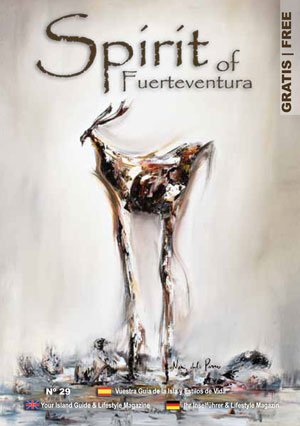 Welcome to the Edition 29 of the Spirit of Fuerteventura Holiday, Trip & Travel Guide + Sport, Activity & Excursion Advisor. On this page you will find all the navigation facilities to bring you to the information contained in this edition.
Enjoy your reading. The Spirit Team.


BIDI: Scan this QR-Code to get your FREE Fuerteventura Guide for Smartphones & Tablets! If you don't have the scanning program yet, download it for free from www.getscanlife.com
 |
Spirit of Fuerteventura pages at Facebook |