












Spirit of Fuerteventura welcomes you on their page “Nature & Science” where you can find info on different topics like ecology, local flora and fauna, etc and on scientific topics.
 | | 
There are 8 species known of the marine turtles that are found in the subtropical and tropical seas. These species originated from about 60-10 million years ago and developed from a much more ancient ancestor, some 200 million years ago. Some 130 million years ago, they were abundant and managed to survive cataclysmic events, unlike the dinosaurs. But since then, they have not changed significantly. They have a characteristic shape due to their bone shell that covers the viscera and efficiently protects them. Read more... Add new comment Hits: 559
|
 The marine turtles visit the Canary Islands on their migration from the US coasts to Africa. Although they visit these islands all year, the peak is in the summer.
|
|
2014 Read more... Add new comment Hits: 755
|
Astronomy Calendar 2014 for Fuerteventura. Stars, planets, meteorites and other celestial events. Read more... Add new comment Hits: 1724
|
This astronomy calendar of celestial events for Fuerteventura contains dates for notable celestial events including moon phases, meteor showers, eclipses, oppositions, conjunctions, and other interesting events that can be seen from dark places in Fuerteventura and the northern hemisphere. Most of the astronomical events on this calendar can be seen with unaided eye, although some may require a good pair of binoculars for best viewing. Many of these events and dates used here were obtained from the U.S. Naval Observatory, the NASA/Goddard Space Flight Center. Times are given in Coordinated Universal Time (UTC) which corresponds to the local time on Fuerteventura.
Read more... Add new comment Hits: 3777
|
Shooting Stars over Fuerteventura!
There are still a couple of events on earth that are for free: rain, wind, sunrise, sunset... and shooting stars! In the second half of the year they are prominent and Fuerteventura allows you to take maximum advantage of it, as you can easily find a dark place. Read more... Add new comment Hits: 8843
|

- Sand – Witness of Time
- The Origin of Oceans.
- Plankton
- Nature & Science - Fuerteventura: Biosphere Reserve: Fuerteventura, Island and surrounding Sea.
- Nature & Science - Fuerteventura: Diocalandra Frumenti - a serious threat to Palm Trees.
- Nature & Science - Fuerteventura: Snow
- Nature & Science - Fuerteventura: The Ferret (Mustela putorius furo) | Spirit 19
- Nature & Science - Fuerteventura: The Canarian Sea Lavender on the island of Lobos
- Nature & Science - Fuerteventura: The Swift
- Nature & Science - Fuerteventura: The Podenco Canario
- Super green calendar
- Nature & Science - Fuerteventura: The MONARCH butterfly
- Zentrum für geomagnetische Anwendungstherapie
- Nature & Science - Fuerteventura: Dinosaurs - Extinct by lack of females?
- Nature & Science - Fuerteventura: Real Material World
- Nature & Science - Fuerteventura: The Field of Energy
- Nature & Science - Fuerteventura: Computer & Brain
- Nature & Science - Fuerteventura: Light – the Invisible Component of Life?
- Nature & Science - Fuerteventura: We always have been here
|
|
| Walking - Hiking & Mountain Biking |

|
|
Lifestyle |

Spirit of Fuerteventura - Ed 30
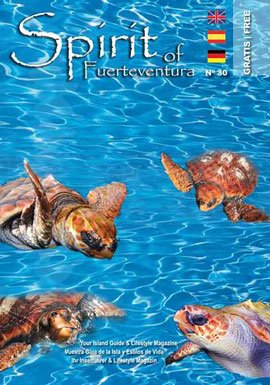 Welcome to the Edition 30 of the Spirit of Fuerteventura Holiday, Trip & Travel Guide + Sport, Activity & Excursion Advisor. On this page you will find all the navigation facilities to bring you to the information contained in this edition.
Enjoy your reading. The Spirit Team.


BIDI: Scan this QR-Code to get your FREE Fuerteventura Guide for Smartphones & Tablets! If you don't have the scanning program yet, download it for free from www.getscanlife.com
 |
Spirit of Fuerteventura pages at Facebook |