












 |
| 
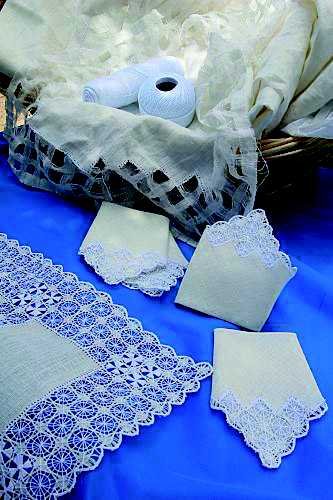 Depending on the consulted source of information, lace was introduced to the Canary Islands in the 19th century from mainland Spain or from Madeira. Before commercialisation by English entrepreneurs, making lace on Fuerteventura was a domestic activity. It soon became famous for its quality and the export to the UK and USA was booming during 1890 - 1910. Export to Germany and France followed soon. Main areas of production on Fuerteventura were Lajares, La Oliva and Betancuria.
The materials that were used are linen, batiste, silk and poplin, depending on the final product. However, one of the exporters took a couple of Canarian lace makers to Japan to teach the local workforce the manufacturing technology and subsequently the Canary lace making industry suffered a decline, mainly due to competition from Hong-Kong (China) at a later stage.
Nowadays, the local government supports this craft by allowing children and youngsters to learn it in a workshop in Puerto del Rosario and by creating outlets that are specialised in local craft products (Betancuria, Molino de Antigua, Airport).
Michel
|
|
| Walking - Hiking & Mountain Biking |

|
|
Lifestyle |


BIDI: Scan this QR-Code to get your FREE Fuerteventura Guide for Smartphones & Tablets! If you don't have the scanning program yet, download it for free from www.getscanlife.com
 |
Spirit of Fuerteventura pages at Facebook |